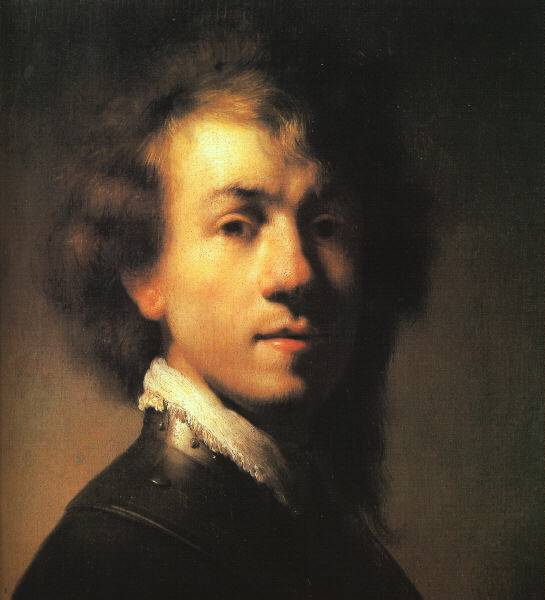
Rembrandt
van Rijn (1606–1669) is perhaps the quintessential Reformation artist. He began
his artistic career following in the footsteps of his contemporary painters.
His style in his youth was not unlike that of the great Flemish painter Peter
Paul Rubens (1577–1640): dramatic, sweeping, and idealized. As the
circumstances of his life darkened, and his faith was tested, the changes that
took place in his spirit became evident through all his paintings. Rembrandt
had experienced a true turning point in his life that forced him to begin to
take his faith seriously, rather than use his faith as a mere tool from which
to obtain motifs for his paintings. While Rembrandt was not as overtly
influenced by the Reformers as Bach evidently was, the Reformed notions of the
person and work of Christ, salvation, and the centrality of the Bible stand out
clearly in his work.
Rembrandt’s
maturation as an artist can be traced alongside the circumstances of his life.
During his early years, he was influenced by his contemporaries, especially
Lastman, his tutor. Lastman developed his style in Italy, using motifs from history
and the Bible. The art of the Counter-Reformation, with its emphasis on
idealizing the subjects of the Bible, was dominant in Flanders
during Rembrandt’s life, and this style had a powerful influence on Rembrandt
at first. Rembrandt in his youth was attracted to the Bible not primarily
because of its spiritual worth or because of its authority in the faith of the
Church, but because it offered a plethora of dramatic themes fraught with
heroes and villains and dazzling victories and ignominious defeats.
In
the years after the death of his wife, Saskia, and his impending financial collapse
(1648–1656), Rembrandt’s shift in style became more apparent. Rembrandt faced a
crisis of faith, and his attitude toward his standing with God changed
dramatically. He realized that he was in no position to pridefully assert
himself, in no position to find his security in his wealth. No longer did
Rembrandt look to the Bible simply as a sourcebook for new themes for his
artwork. The Bible became his link to God, and the source of his spiritual
vitality as well as his art. Instead of merely painting the subjects of the
Bible, he interpreted the Bible in his art, much as Bach had interpreted the
Bible in his music.
Abraham’s
obedience on Mt. Moriah, as recounted
in Gen 22, is a favorite subject of Rembrandt’s. The first time that Rembrandt
depicted this theme in 1635 (The
Angel Stopping Abraham from Sacrificing Isaac to God), he was a
young and wealthy artist living in Amsterdam. He had not yet made his shift
from idealism to realism—the Reformation standard of depicting God’s world
without theatrics had not yet made its impact on Rembrandt. It is remarkable to
compare his first depiction of this theme in 1635 with his second depiction of
1655. In the first example, shown below, we have the earlier painting, and Rembrandt’s
dramatic portrayal of the biblical event is clear. Abraham has stretched his
son out upon the altar, clasping the boy’s face and widely exposing his neck
for the slice of the knife. Rembrandt captures the moment when the angel stops Abraham,
so the viewer sees the knife drop from his hand and the look of surprise and
amazement on his face. The typical Baroque obsession with the drama of the
miracle and the movement of the subjects is evident in this piece.
 |
| The Angel Stopping Abraham from Sacrificing Isaac to God |
But
compare this work with the second piece (Abraham’s
Sacrifice), painted in 1655, when Rembrandt’s wisdom and the influence of
the Reformation ideal of faith and simplicity are more obvious. The emphasis in
this later work is upon Abraham. This earthly father who has been confronted
with a crisis of faith without comparison is about to offer the supreme act of
obedience to God’s command. The conflict that raged with Abraham’s spirit is
depicted in this etching. It is the inner reality that Rembrandt emphasized in
this work, not the outward dazzle of the intervention of the angel of the Lord.
Isaac, in contrast to the earlier painting, is not stretched out on an altar,
but kneels humbly at his father’s side. He is not a muscular, superhuman figure
as he is in the 1635 depiction, but is a small boy in the later one. The angel
comes from behind Abraham, and is invisible to him, rather than revealing
himself in splendor. Note that Abraham’s eyes are darkened, likely demonstrating
that his faith is blind. Abraham, as Rom 4:3 reveals, was a man who believed
God, and God accounted his faith to him as righteousness. The stark differences
between the two works are evident even in their titles. The 1635 depiction has
a long and descriptive title, one that underscores the drama of the miracle
itself. In contrast, the title of the 1655 depiction is a simple one, leaving
the viewer to find its meaning in the work as well as the biblical text.
 |
| Abraham's Sacrifice |
Rembrandt van Rijn’s life presents us with a powerful example
of how Christ fundamentally alters one’s perspective on life. Having been given
new life in Christ, Rembrandt saw himself under His gaze, and his response was
to humble himself and to become Christ’s servant. Hundreds of years later, we
are still benefiting from the devotion of Rembrandt to Christ that is
reflected in his art.
[This is part of a more extensive article I wrote entitled “The Impact of the Reformation on the Fine Arts with Emphasis Upon Selected Works of Johann Sebastian Bach and Rembrandt van Rijn.” Faith and Mission 23 (Spring 2006): 31–54.]
[This is part of a more extensive article I wrote entitled “The Impact of the Reformation on the Fine Arts with Emphasis Upon Selected Works of Johann Sebastian Bach and Rembrandt van Rijn.” Faith and Mission 23 (Spring 2006): 31–54.]


No comments:
Post a Comment