
The goal of
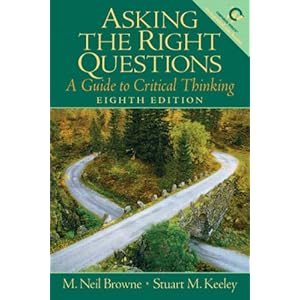
Asking the Right Questions is to give
the reader some tools to use when evaluating the reasons given for a particular
conclusion in a specific argument. The authors state early on that critical
thinking is a term meaning three components: 1) “awareness of a set of
interrelated questions,” 2) “ability to ask and answer critical questions at
appropriate times,” and 3) “the desire to actively use the critical questions”
(2). The authors’ purpose is to help the reader build these skills of critical
thinking and use those skills not only in what they hear and read, but also in
what they speak and write themselves. Critical thinking skills are set in
contrast with a simple act of absorbing information as it comes in the first
chapter. While it is valuable and right to absorb information as it comes in
the form of writing or speaking, it is not enough to stop there. Critical
thinking does absorb information, but it takes the information and evaluates it
in order that an independent and intelligent conclusion may be reached.
The book is
divided into fourteen chapters. Chapters 1 and 14 deal mostly with various
introductory and concluding issues, while the substance of the book is met in
chapters 2 through 13. These chapters, each in their turn, deal with the
critical questions in the order that they may be asked. As the reader proceeds
through the chapters, the critical questions become more and more complex. The
critical questions which the authors present are centered around the following:
1) issue and conclusion, 2) reasons, 3) ambiguous terms and phrases, 4) value
conflicts and assumptions, 5) descriptive assumptions, 6) fallacies, 7)
evaluation of evidence, 8) rival causes, 9) potentially deceptive statistics,
10) potentially omitted information, and 11) possible reasonable conclusions.
The book is
designed so that the reader may master each critical question by reading the
material in the chapters, encountering and considering the examples offered,
and working the practice exercises at the end of each chapter. More practice
exercises are offered on the book’s website to the ambitious learner. The practice
exercises provided by the authors are certainly valuable, but it is better to
try the skills out on actual articles, editorials, speeches, and other sources.
Doing this is much more challenging, as well as much more practical. Once the
reader has proceeded through the entire book, he should have a good idea about
how to think critically about any issue, whether it is found in written or
spoken form. The chapters are meant to be analyzed individually, but then taken as a whole
package once they are studied in their entirety.
The
intended audience is primarily an academic one, although the authors make clear
at the outset that everyone with sufficient motivation may hone their critical
thinking skills using the questions addressed in the text. I have found this to be true, having
recently taught an eighth grade logic class through this book and seeing the
effect of the application of critical thinking skills upon young teenagers.
Once the
authors have concluded their practical study on critical thinking, they close
their book with some helpful advice on the tone of critical thinking. Several
suggestions are offered in order to communicate friendship rather than
hostility while exercising critical thinking skills. It was refreshing to see
the authors stress that, even if we are being misled or tricked in some way by
a politician, salesman, lawyer, etc., it is always imperative to offer
argumentation in a positive and edifying spirit. This is especially important
to remember in an often adversarial society, as well as one whose general idea
of argumentation and critical thinking too often insists scoring victory at any
cost.
Browne, M. Neil and Stuart M. Keeley. Asking the Right Questions: A Guide to Critical Thinking, 10th
edition. New York: Longman, 2011.


No comments:
Post a Comment