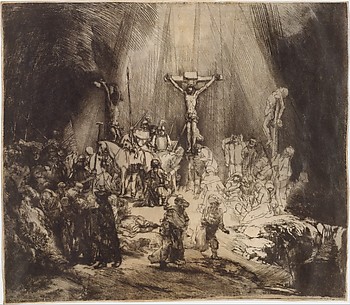
Death is a central theme in Christianity. The Christian faith does not cower before death, does not consider it a morbid topic, and does not sweep it under the rug. The Christian faith teaches us that death itself died at a place called "The Skull" when the Lord of life died a sinner's death.
When the soldiers took Christ to Golgotha (Calvaria, from the Vulgate), the Spirit through Matthew says that they gave Him wine mixed with gall to drink. He who had changed water to wine early in His ministry, demonstrating His sovereign power over nature and His ability to transform that which is ordinary into that which is extraordinary, was now given an amalgam of wine and gall to drink at His tortuous death. The passage goes on to say that the Roman soldiers stripped Him of His garments and cast lots to see who would get to keep them. He whose garments themselves were the object of a sick woman's grasp (Mark 5), and from which power proceeded to heal her, was now stripped naked and humiliated as He was nailed to the cross. He who had been the friend of sinners, prostitutes, and tax collectors was now being crucified with sinners as though He were a great sinner Himself.
They put Him between two highwaymen when they crucified Him. The Romans wanted to make an example out of Him because He was accused of sedition. They crucified offenders on the main roads outside city gates to warn travelers entering the city against breaking the laws. (Imagine riding into your hometown on the main drive just outside of town and seeing condemned men hanging from crosses on your way into town.) He was "numbered with the transgressors" even though He had done nothing wrong (Isa 53.12). He was charged by Rome with being "King of the Jews." What the Romans had done to shame Him, God used to glorify Him.
He was mocked: mocked by travelers passing by, mocked by the chief priests, scribes, and elders of the Jewish people, mocked by the two thieves who were nailed to crosses next to Him. They mocked Him for His teachings. They mocked Him for His claims. They mocked Him because of His gracious and miraculous acts on behalf of others that He had done throughout the country. All this mockery was fulfilled in the Scriptures in Psalm 22, written 900 years before Jesus was born--"But I am a worm and not a man, a reproach of men and despised by the people. All who see me sneer at me; they separate the lip, they wag the head, saying, 'Commit yourself to the LORD; let Him deliver him; let Him rescue him, because He delights in him;' . . . For dogs have surrounded me; a band of evildoers has encompassed me; they pierced my hands and my feet. I can count all my bones. They look, they stare at me; they divide my garments among them, and for my clothing they cast lots."
Christ Himself cried out with a loud voice that which was written in Psalm 22.1--"My God, My God, why have You forsaken Me?" Indeed, Christ had been given over to His enemies and to death, but God had not abandoned Him. Jesus cried out again with a loud voice, "Into Your hands I commit My spirit" (Luke 23.46) and "It is finished" (John 19.30). Had God abandoned Him, He would have had no one to whom to commit His spirit. The Father took His Son, and accepted Him as the atoning sacrifice.
Notice also that at His death, He cried out with a "loud voice." He did not die with a whimper. He died exhibiting strength and resolution! Christ said in John 10.17-18 that no one took His life away from Him. Rather, He had power to lay it down and power to take it up again. The Jews didn't kill Jesus, neither did the Romans. Nobody took His life from Him. He laid it down of His own accord, and He took it up again on the third day.
The veil of the temple was torn in two, demonstrating that Christ's death opened up access to God once and for all. No longer would we require a human intercessor to go to God on our behalf. No longer would we be separated from God by a great barrier. Through Christ's atonement, the way is now open for anyone who believes in Jesus to come to God boldly with confidence to find help in time of need (Heb 4.16).
When Christ died, there was deep darkness and an earthquake. When the Roman centurion who was guarding Jesus as He died saw it, He said, "Truly this was the Son of God!" Even this pagan knew who Jesus was when He watched Him die. What do we say of Jesus?
Furthermore, what could compare with Jesus' death on the cross? What of our merits can be of more value than what we see described in Matthew's gospel? Church work?? Good deeds?? Baptism?? All of it is filthy, and of no account! When He died on the cross, Christ became sin for us, that we might become His righteousness (2 Cor 5.21). He took the blame for all the evil things we have done, and we get the credit for all the righteous things He did--if we put our confidence in Him and Him alone.
God be praised and thanked for His indescribable gift in Jesus Christ who died, was buried, and rose again on the third day. "O Death, where is your sting? O Grave, where is your victory?" (I Cor 15.55).


Great song!
ReplyDelete